
Your Customers Have a Network Documentation Problem. Here’s How to Recognize It.
Five signs to listen for in hardware, fiber and data center conversations
Consider a routine hardware conversation. A customer is planning to buy new switches. Before the installation can move forward, someone needs to confirm the available rack space, the patch-panel connections and the path back to the core.
The answers are spread across a spreadsheet, a drawing and someone’s memory. The customer has a clear plan for buying equipment. Finding the information needed to install it takes another round of calls.
That is an opening for a network documentation conversation.
For resellers, netTerrain provides a way to address that need alongside network, data center and fiber projects. It combines network documentation, Data Center Infrastructure Management (DCIM) and Outside Plant (OSP) capabilities in a visual infrastructure platform.
You can recognize a potential fit by listening for these five signals.
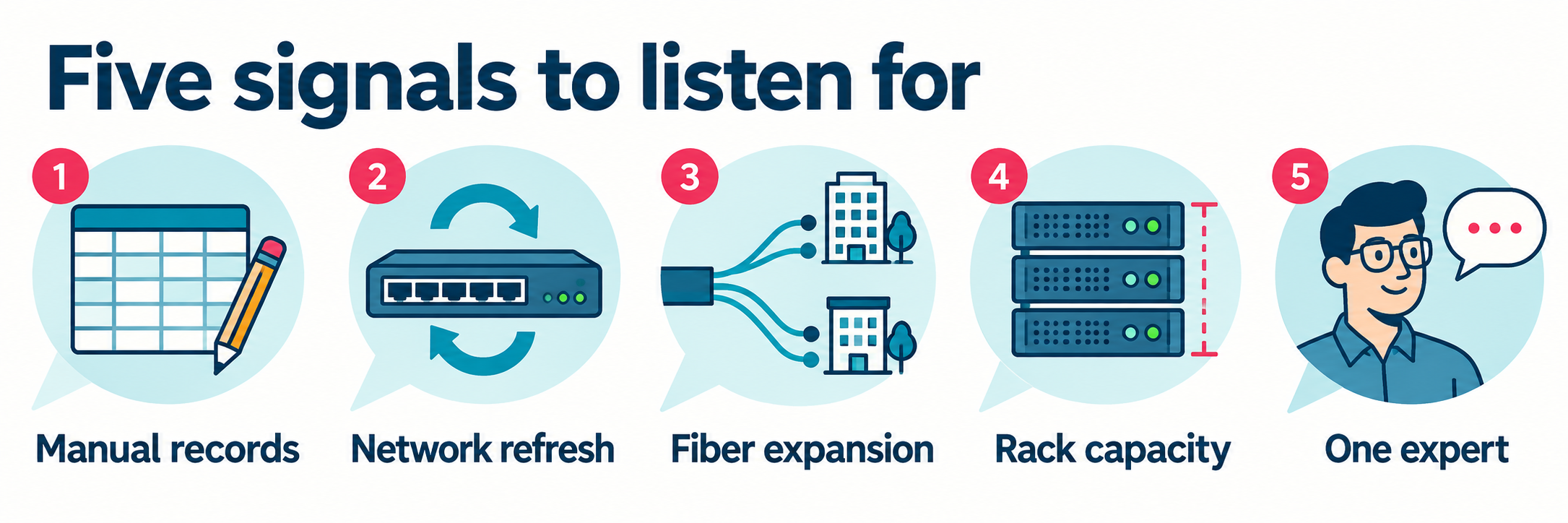
1. “We’re Still Using Spreadsheets and Visio.”
The useful signal is the effort required to keep the information aligned.
A spreadsheet might list equipment. A Visio drawing might show racks. Cable records may live somewhere else. When a device moves or a connection changes, someone has to find and update each relevant record.
The consequence appears in ordinary questions: Where is this device? Which port does it use? What is connected at the other end?
If answering means opening several files and checking with another person, the customer has described a practical documentation problem.
Ask: “When something changes, how do you update the records—and how does the next person find the current answer?”
That question reveals both the maintenance burden and how much confidence the customer has in its information.
2. “We’re Upgrading or Modernizing Our Network.”
A refresh introduces new switches, routers, racks and connections. It also creates information the operations team will need after installation.
The project may produce drawings, equipment lists and test records. The next question is how those records will be connected and maintained when the project team moves on.
This matters while the work is being scoped. Documentation responsibilities are easier to discuss while the customer is deciding what the project must deliver.
Ask: “What will the operations team use to document the new environment after cutover?”
Listen for who will own the records, how changes will be captured and whether the customer has chosen a system for the ongoing work. Those answers help establish whether documentation belongs in the conversation now.
3. “We’re Installing or Expanding Fiber.”
A route on a map is one part of a fiber record. The customer may also need to know which conduit contains the cable, where strands are spliced, how a circuit reaches its endpoint and which capacity is available.
Those questions become relevant when a campus adds a building, a utility expands service or an organization upgrades its fiber backbone.
netTerrain’s OSP capabilities connect geographic views with infrastructure details, including cables, strands, splices, circuits and indoor connections. Existing spreadsheet and KML/KMZ information can provide a starting point, with validation needed as the record is built.
Ask: “Can your team trace a fiber circuit and identify available strands from its current records?”
A difficult answer can reveal a need beyond the equipment being purchased.
4. “We Don’t Really Know What’s in Our Racks.”
This conversation may begin with inventory, but it often reaches planning.
The customer needs to install more equipment. Before approving the work, the team needs reliable information about the rack, the devices already installed and the connections the new equipment will require.
If that information is incomplete, planning can turn into another room visit or a manual check.
netTerrain’s data center capabilities support documentation of racks, equipment, ports, cabling and capacity information so teams can investigate those questions through their infrastructure records.
Ask: “How does your team confirm rack space, power and connection capacity before planning an installation?”
The answer helps distinguish the information the customer already has from the information it still needs to collect and maintain.
5. “Only One or Two People Know How Everything Connects.”
An experienced employee may know which cable takes an unusual route, why a connection was changed or where an old project’s drawings were stored.
That knowledge is valuable. The operational problem appears when every difficult question has to wait for that person.
A retirement, role change or growing workload can make the need for a shared record more urgent.
Ask: “If that person were unavailable next week, could someone else trace the connection and understand the records?”
Graphical Networks’ published BWI case study describes a related concern: preserving the knowledge of the person responsible for the airport’s fiber connections so a future successor could use it.
That is a concrete reason to discuss documentation. The customer needs a way to make experienced employees’ knowledge useful to the wider team.
Turn the Signal Into a Useful Conversation
A mention of spreadsheets or an upcoming refresh gives you a starting point. A stronger opportunity includes a specific question the customer struggles to answer and a reason to address it.
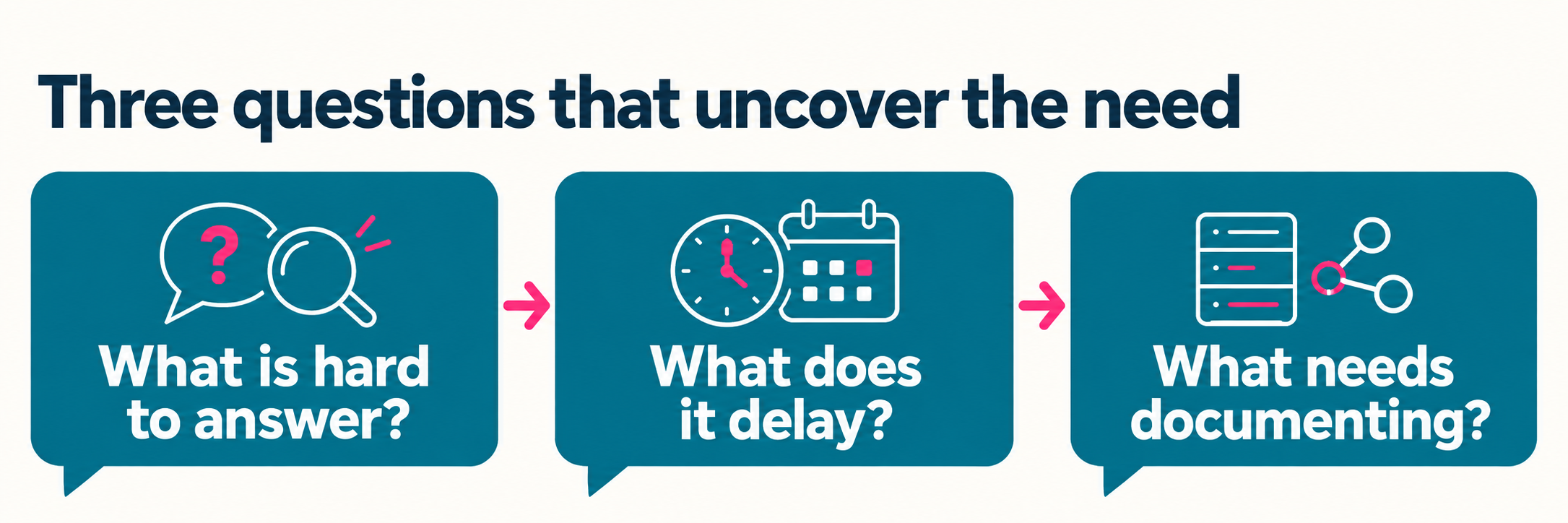
Keep the next conversation focused:
- Hear the signal. What is the customer having difficulty documenting?
- Ask what it delays. Is it slowing an installation, a capacity decision, troubleshooting or a handoff?
- Capture the scope. Which sites, racks, devices, connections or fiber assets are involved?
- Bring in Graphical Networks. Use those details to explore whether netTerrain fits the customer’s requirements.
A maintained infrastructure model still depends on usable data, validation and clear responsibility for updates. Those are useful topics to raise early.
You already have a reason to ask about the infrastructure. Add one question about how the customer documents it, and you may uncover a need that belongs in the project.
Have a customer facing one of these problems? Bring the use case to Graphical Networks and see how netTerrain could fit.
