Before Your Next Utility Fiber Change, Can You Trace Every Circuit It Affects?
Suppose your utility needs to replace a splice enclosure along an existing fiber route.
The location is mapped. The contractor has the work order. The maintenance window is on the calendar.
Then someone asks:
“Which communications circuits will this affect—and does the alternate path stay clear of the work?”
Can your team answer from the records in front of them? Or does the answer require a spreadsheet, a separate splice diagram, an old project folder, and a call to the person who remembers the last change?
That is the problem worth solving before the maintenance window begins.
The goal is not simply to know where the fiber runs. It is to understand what connects through it, what depends on those connections, and what needs to be checked before anything changes.
netTerrain brings outside plant mapping, fiber inventory, and circuit tracing into one visual system. Its outside plant capabilities let teams move from geographic routes to the cables, strands, and connections documented within them.
Here is how to put that visibility to work around a planned fiber change.
Start With the Affected Circuits—Not Just the Affected Cable
A work order might identify a cable, splice enclosure, or patch panel. Your maintenance review needs to go further.
For the portion of the network being changed, ask which strands are involved, which circuits use those strands, and where those circuits terminate. Then connect that information to the service owners who need to participate in the review.
Consider a planned resplice. Knowing the cable identifier is useful. Knowing the strand assignments is better. Being able to follow the documented circuits through those strands gives the team something more useful to review than a cable label alone.
In netTerrain, circuits are associated with the physical strands and endpoint ports supporting their paths. Circuit properties can also include custom fields, allowing teams to record information relevant to their own operations.
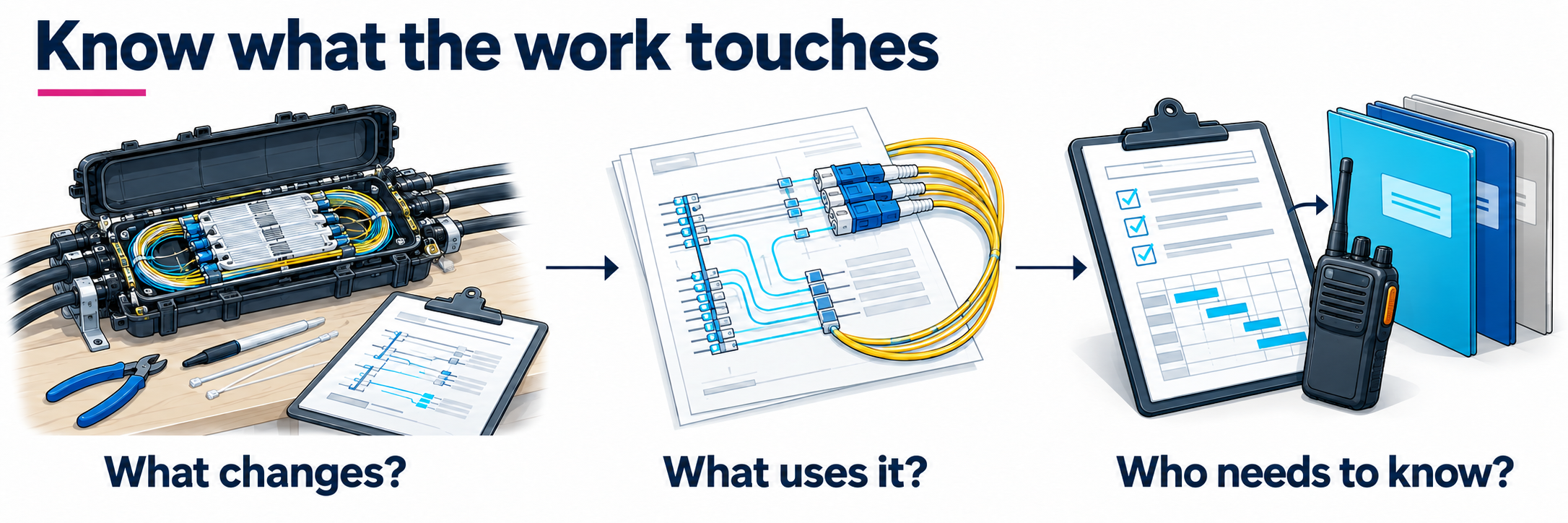
Use those relationships to build the maintenance discussion around three questions:
What are we changing? What uses it? Who needs to know?
Do not treat an undocumented dependency as proof that no dependency exists. Make the uncertainty visible and assign someone to resolve it before the work proceeds.
Follow the Connection Through the Splice—and Into the Building
Finding the cable on a map is a starting point. For a connection-level review, keep going.
Follow the relevant strand through each splice point. Check how the incoming strand connects to the outgoing strand. Continue to the termination, including the patch panel and port where applicable.
netTerrain supports modeling splice connections at the strand level, including the connection points within splice boxes.
That makes it possible to document the actual cross-connections rather than relying on an assumption that strand colors or numbers continue unchanged through every enclosure.
The review should not stop at the building entrance, either. netTerrain can represent outside plant and inside plant relationships, with circuit layout records providing an end-to-end view of documented circuit paths.
For the maintenance review, ask a colleague who did not prepare the records to follow the connection.
Can they understand the path without a separate explanation? Can they identify the termination? Can they tell which information has been verified and which still needs checking?
That is a useful test of whether the documentation is ready to support someone other than its author.
Check the Alternate Path—Not Just the “Redundant” Label
“We have a backup” should begin a review, not end it.
Imagine two communications paths that use different strands but pass through the same enclosure scheduled for replacement.
The second path may be an alternative connection, but it does not avoid that work location.
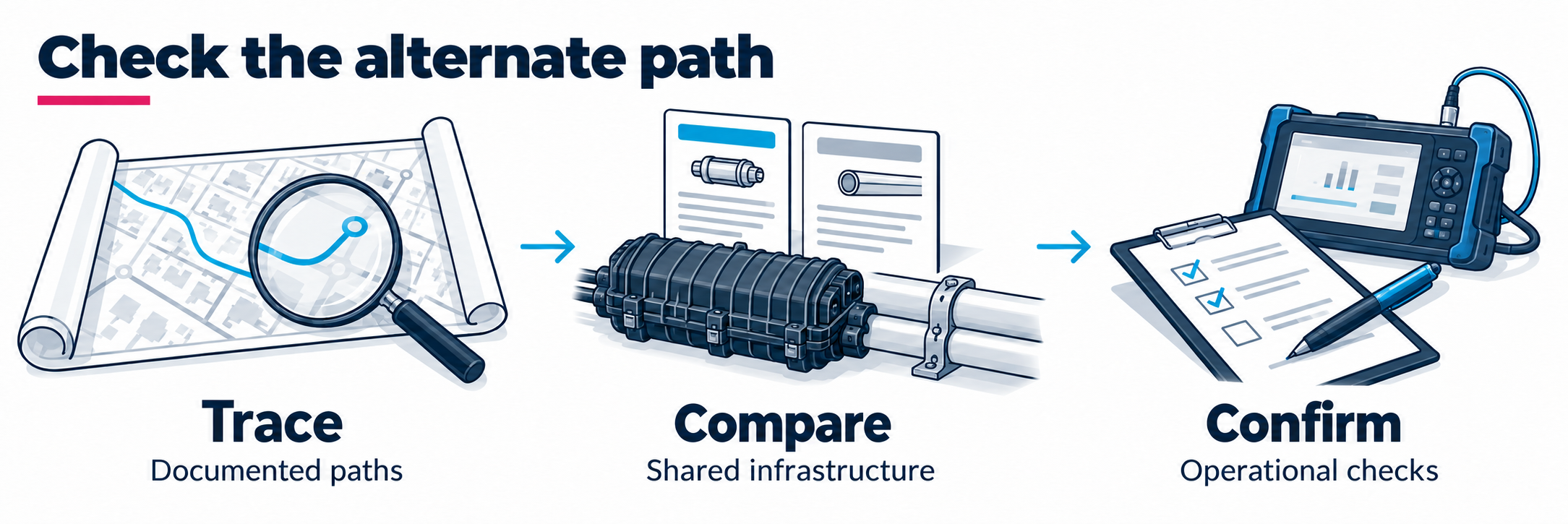
Before relying on an alternate path, compare its documented physical route with the proposed work area. Look for shared cables, enclosures, conduits, and other infrastructure relevant to the change.
netTerrain supports multiple paths for a circuit, including main and secondary paths, and distinguishes between diverse and redundant paths in its circuit documentation.
Those capabilities support reviewing the physical relationships represented in the model.
A documented alternate path is not the same thing as tested failover.
Keep the documentation review connected to your utility’s approved operational checks.
Confirming equipment readiness, configuration, capacity, and failover behavior belongs with the responsible teams and their procedures—not with an assumption drawn from a diagram.
Use the model to make the questions specific. Use the operational review to establish whether the proposed arrangement is ready.
Make the Record Update Part of the Work
Before the maintenance window, agree on what must be documented when the work is complete.
For a resplice, that might include the actual strand connections, revised circuit paths, changed terminations, and any differences between the plan and the completed work.
For a new connection, it might include the resources used and the status of strands previously shown as available.
Give that update an owner.
Specify who checks it. Include it in the closeout requirements rather than leaving it as an informal handoff.
A useful closeout question is:
“Could someone who was not here today understand what we changed?”
The target is not a folder containing more documents.
It is a usable record of the network that now exists.
Keep planned changes distinguishable from confirmed, completed changes. Where the field work differs from the design, reconcile the difference rather than allowing both versions to circulate without explanation.
Already Have GIS? Test the Workflow, Not the Label
This is not an argument that GIS cannot manage fiber connectivity.
GIS-based communications systems can support detailed network models and circuit management.
The practical question is whether your current implementation gives the people reviewing the change the information they need.
Can they move from the work location to the relevant strand connections?
Can they follow the associated circuit to its endpoints?
Can they review the alternate path?
Can the completed change be reflected in the records used for the next maintenance window?
If your current system handles those tasks well, build on that.
If the answers are divided among separate tools and files, focus on the missing relationships—not simply on producing another map.
Five Questions for Your Next Fiber Maintenance Review
Use these questions to expose documentation gaps before the work begins. They support the review; they do not replace your utility’s approval, testing, or safety procedures.
1. What exactly are we changing?
Look for identified cables, strands, splice connections, panels, and ports within the work scope.
2. Which circuits could be affected?
Look for traceable circuit paths, endpoints, and the associated owners or services your team has documented.
3. Does the alternate path avoid the work?
Compare the physical routes and identify relevant shared infrastructure and unresolved questions.
4. What still needs verification?
Clearly identify gaps, give each check an owner, and decide what must be resolved before proceeding.
5. Who updates the records afterward?
Name the owner, specify the required updates, and include a review step tied to work completion.
The point is not to make every maintenance review longer. It is to stop making the same information search part of every maintenance review.
What This Looks Like When the Records Become Usable
The exact environment may be different, but the operational pattern shows up in other organizations managing distributed fiber and communications infrastructure.
Pitkin County: Less Reliance on Memory and Field Inspection
Pitkin County, Colorado manages a sprawling telecommunications environment that includes 13 mountaintop communications sites, 34 microwave hops, more than 1,800 radios, broadband infrastructure, and public-safety communications.
Before netTerrain, its documentation relied heavily on Google Sheets and Drive. Identifying dark fiber strands, dealing with fiber cuts during emergencies, sharing information with partners, and understanding hard-to-access locations could require institutional knowledge and physical inspection.
After moving to centralized documentation in netTerrain, the county reported better visibility from inside-plant infrastructure to fiber paths, fewer manual inspections, faster access to information during emergencies, and improved collaboration with partners.
For a utility maintenance team, the lesson is straightforward: the value of documentation appears when someone needs an answer quickly without first reconstructing the network from memory.
Explore the Pitkin County and other netTerrain customer stories →
City of Seguin: From Field Trips to Street-to-Strand Visibility
The City of Seguin, Texas faced a different version of the same problem. Its team was using spreadsheets, paper drawings, and Visio to document a growing municipal infrastructure environment.
Without sufficiently detailed visualization, employees sometimes had to travel into the field simply to determine what was at a site. As construction continued and the fiber network expanded, keeping those records current became increasingly difficult.
With netTerrain, Seguin documented both aerial and underground fiber and gained the ability to work from the citywide view down to strand-level and termination information. The team reported better planning, easier collaboration, knowledge retention, and more confidence when planning expansion and new construction.
Maintenance documentation is valuable for the same reason: it should reduce guesswork before people are standing in the field trying to determine what the records should already tell them.
See the City of Seguin case study and more customer results →
Give the Teams Involved a Connected View
The need to connect tools and departments is not unique to a single fiber project.
In a published netTerrain customer testimonial, Javier Iriarte, Communications Manager at Acciona Energía, described the company’s need this way:
“We needed a way to unify both the tools and the departments. netTerrain delivered.”
That is a useful goal for a utility fiber workflow: not another diagram that only one person understands, but documentation that helps engineering, network operations, and the people responsible for field changes discuss the same connections.
Start With One Planned Fiber Change
You do not need to begin the evaluation with every cable your utility owns.
Choose one upcoming project: a resplice, an enclosure replacement, a new site connection, or a route change.
Identify the questions your team needs to answer, then use that project to evaluate how the documentation should work.
Existing records can provide a starting point. netTerrain supports importing spreadsheets and KML/KMZ data, alongside other import options, so evaluating a connected model does not have to mean re-entering every record from scratch.
Imported information still needs to be checked for completeness and accuracy.
Bring one planned fiber change to a netTerrain demo.
Tell us what your team needs to change and which connections are difficult to trace.
Ask us to demonstrate the relevant workflow: locating the infrastructure, following documented strands and circuits, reviewing alternate paths, and maintaining the resulting records.
A high-level description or anonymized example is enough to start the conversation. There is no need to send sensitive network diagrams with your initial request.
Before the next maintenance window, make sure the conversation can move beyond “Where is the fiber?” to “What depends on the part we are about to change?”
