FAA Fiber Cut Disrupted Thousands of Flights. Where the Failure Chain Could Have Been Interrupted
A severed backup fiber line and a failed primary communications circuit disrupted air travel across the Northeast US for hours. The sequence shows why physical route visibility matters—and BWI Airport offers a separate, real-world example of what that visibility looks like.
The September 21 FAA communications outage was not one failure.
It was a sequence.
- Workers accidentally cut a telecommunications line in New Jersey used by the FAA.
- A primary communications circuit serving the Philadelphia Terminal Radar Approach Control facility then failed.
- When the FAA attempted to move communications to the backup, officials discovered that the backup fiber was broken.
- Airports across the Northeast US stopped accepting incoming flights while the problem was resolved.
About 7,000 flights were delayed or canceled that day, according to Reuters. By the following day, the disruption and its aftermath had affected roughly 9,500 flights.
For transportation infrastructure teams, the useful question is not simply what failed.
It is where the chain could have been interrupted.
The Outage Exposed Three Different Defensive Layers
- Before excavation: know what is buried and locate it accurately.
- In the network architecture: a backup connection must provide meaningful resilience when the primary path becomes unavailable.
- When those defenses still fail: teams need to understand the affected physical infrastructure fast enough to respond.
All three depend, in different ways, on knowing the physical network.
That is where netTerrain OSP fits. It provides a system of record for outside plant and fiber infrastructure, allowing teams to move from geographic routes into cables, circuits, strands, splices, conduits, handholes and connected equipment. The point is not simply to draw a route. It is to be able to follow what is actually there.
 IDC MarketScape Graphical Networks Named a Major Player in the 2026 IDC MarketScape See netTerrain
 BWI Was Not Part of the FAA Outage—Its Fiber Documentation Offers a Useful Contrast
Baltimore/Washington International Thurgood Marshall Airport had thousands of connections spread across multiple locations.
Its team needed to identify where fiber was located, determine capacity, understand endpoints and simplify circuit management. It also wanted to reduce field trips and retain the network knowledge accumulated by the person managing the fiber.
One BWI goal captures the problem particularly well:
“eliminate the need to walk miles to figure out where fiber goes.”
The airport also wanted to provide its team with information that could assist troubleshooting without delay.
That changes the standard for useful documentation. The question is no longer whether an organization has drawings. The question is whether someone can ask “Where does this go?” and get an answer.
BWI’s next problem was that maintaining those answers took too long.
BWI Cut Circuit Documentation From 30 Minutes to Less Than One
BWI was not starting from nothing. It already used software to document its fiber.
But entering one circuit took approximately 30 minutes.
With thousands and thousands of connections, that was not sustainable.
BWI selected netTerrain DCIM with the OSP module. One person was then able to document thousands of connections across exterior buildings, maintenance locations and other facilities, as well as Martin State Airport.
The measurable change was significant:
Approximately 30 minutes to document one circuit became less than one minute.
That number matters because documentation has to stay usable after implementation day. A network record that takes too much work to maintain will eventually stop describing the network that actually exists.
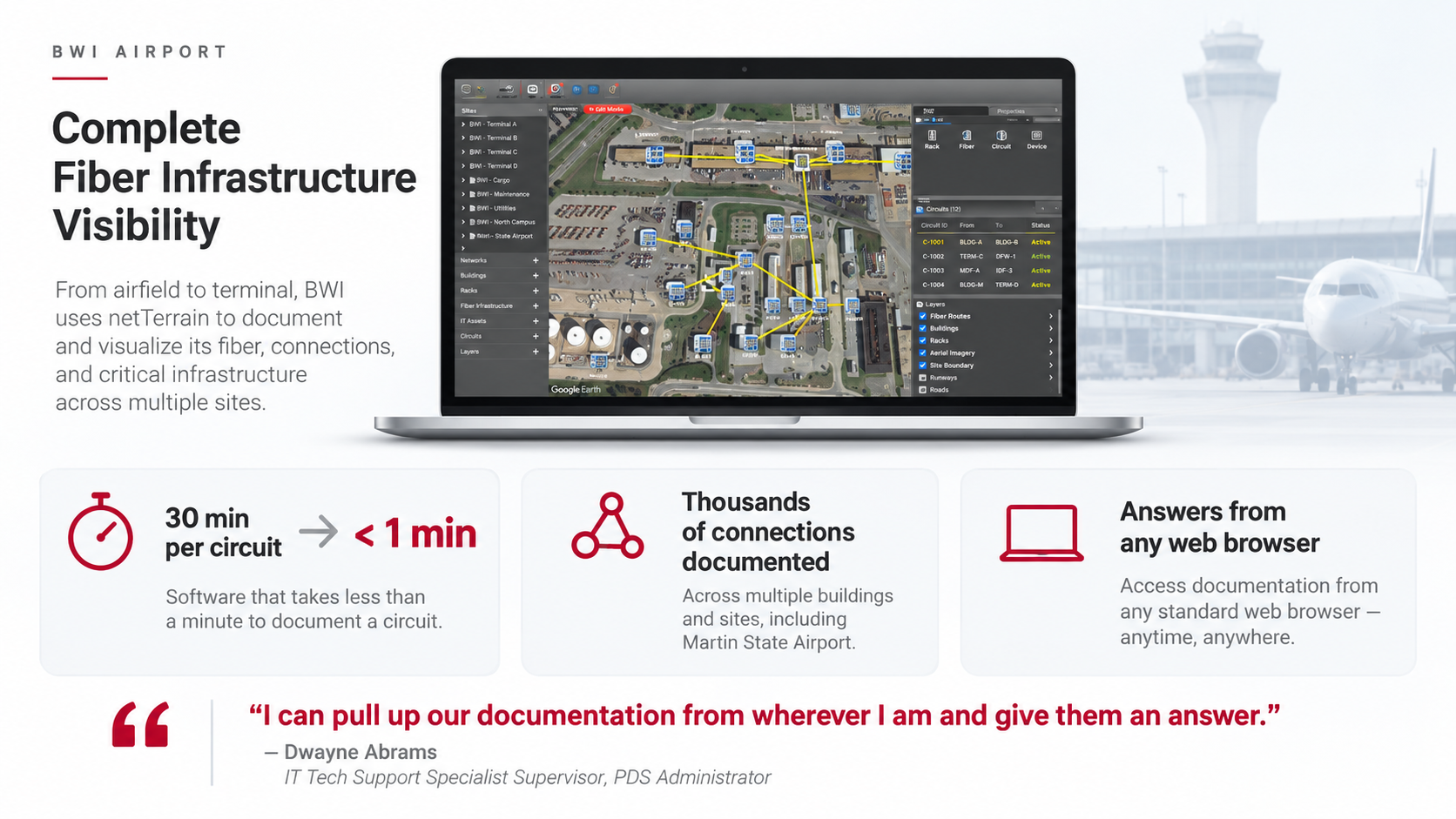
At BWI Airport, netTerrain provides browser-based access to thousands of documented connections across multiple sites. BWI reports reducing circuit documentation time from approximately 30 minutes per circuit to less than one minute.
Read the full BWI Airport case study: BWI Airport case study
Once BWI had the information documented, the next benefit was simpler: the answer became available without walking the route.
BWI Could Answer Fiber Questions From a Browser
The BWI case study says the days of walking miles of cable simply to determine where it went became a thing of the past. Fiber information could instead be accessed through a web browser.
Dwayne Abrams, who managed BWI’s fiber documentation, described the effect:
“netTerrain has saved us an unbelievable amount of time.”
More importantly:
“If the network guys have a question, I can pull up our documentation from wherever I am and give them an answer.”
That sentence gets close to the real purpose of infrastructure documentation.
- Someone has a question.
- The network record should contain the answer.
For an airport or transportation system, that answer may require moving from a geographic route into a conduit, cable, strand, splice or circuit. That is why physical infrastructure needs to be documented as relationships, not just symbols on a map.
See how netTerrain documents fiber from route to strand: netTerrain OSP
And those physical relationships lead directly back to the FAA outage.
The First Defensive Layer Is Accurate Underground Location
The initial break occurred during construction in New Jersey.
Reuters reported that New Jersey Transit said its crew had been digging about 10 feet from the utility markings. At the time, it was still investigating who had made the markings and the circumstances surrounding them.
That detail is important because safe excavation begins with reliable knowledge of underground infrastructure.
The U.S. Department of Transportation’s Pipeline and Hazardous Materials Safety Administration says excavators should contact 811 before digging so underground facility operators can locate and mark infrastructure in the work area. PHMSA also emphasizes respecting those markings and digging carefully around them.
A documentation platform does not replace 811, professional locating or safe-dig procedures.
But accurate asset records give an infrastructure owner something fundamental to work from: a maintained picture of where its own facilities are supposed to be.
That is the first opportunity to interrupt the chain—before the cable is damaged at all.
The Second Defensive Layer Is a Backup Path That Can Actually Carry the Load
Redundancy looks simple on a diagram.
- Primary line.
- Backup line.
The physical world is less simple.
CISA’s communications-resiliency guidance recommends redundant links on separate pathways, at separate provider locations, or both, because physical diversity improves resilience.
The FAA incident demonstrates another side of the same principle: a backup only protects the service if it is available when the primary fails.
FAA Administrator Bryan Bedford said officials discovered the fiber break when the system attempted to switch communications to the backup path. Reuters reported that the break was expected to require extensive repair.
The following day, Transportation Secretary Sean Duffy said the replacement air-traffic-control architecture is intended to eliminate single and dual points of failure and provide multiple telecommunications routes into FAA facilities.
Reuters report on the replacement air-traffic-control architecture
For infrastructure teams, that turns redundancy into a set of physical questions:
- Where does the backup route travel?
- Where does it enter the facility?
- Does it share a pathway, corridor or other physical dependency?
- Where is it spliced?
- What equipment depends on it?
Redundancy is not only a logical relationship. It has geography.
And when redundancy still fails, the third layer becomes critical.
The Third Defensive Layer Is Knowing What Broke—and What It Affects
Once an outage begins, the problem changes. Prevention is over. Now the team needs answers.
- Which cable is affected?
- Which fibers are inside it?
- Which circuits use those strands?
- Which locations depend on them?
- Where are the relevant splice points?
- What other capacity or paths exist?
This is where BWI’s experience becomes particularly relevant.
Its goal was not an abstract “digital transformation.” The airport wanted to stop walking miles to discover where fiber went and to provide troubleshooting information without delay.
With netTerrain, those physical relationships could be documented and accessed in a browser.
That does not repair fiber. It reduces the amount of the network that has to be rediscovered while people are trying to repair it.
The FAA Outage Lasted About Eight Hours
The scale of the September 21 disruption shows what is at stake when communications infrastructure fails.
Reuters reported that incoming flights were halted at JFK, LaGuardia, Newark, Philadelphia and Boston, along with other affected airports. The telecommunications problem was not fully resolved for approximately eight hours, and more than 100 flights were diverted.
The Associated Press also reported widespread disruption after the primary communications line and backup fiber became unavailable.
By September 22, Reuters put the total at roughly 9,500 delayed or canceled U.S. flights connected to the outage and its aftermath.
The incident attracted attention because the visible consequences were airplanes and passengers. The infrastructure underneath the event was much less visible.
That is precisely the problem physical network documentation exists to address.
FAA Modernization Is Moving Thousands of Connections Onto Fiber
The outage also comes during a significant modernization of U.S. air traffic control infrastructure.
A September 2026 Government Accountability Office report says that, as of May, the FAA had replaced 2,560 of 5,170 aging copper connections with high-speed fiber-optic communications cables.
The direction is clear: more critical communications are moving onto fiber.
That makes knowing where the fiber runs, how it is connected and what depends on it increasingly important.
Rail, Transit and Transportation Networks Face the Same Physical Questions
Airports are one example of a much larger infrastructure problem.
Rail systems, transit authorities, DOTs, ports, campuses, utilities and municipalities may operate fiber across large geographic areas. Those networks can support communications, cameras, wireless infrastructure, buildings, operational systems and other services.
The infrastructure differs. The questions stay remarkably consistent.
- Where does this cable go?
- Which strand is available?
- Where is the circuit spliced?
- What route does the backup take?
- What will be affected if this section fails?
Those answers become harder when they are divided among spreadsheets, PDFs, static maps and individual memories.
netTerrain OSP is designed to bring that physical infrastructure into one navigable system of record, from GIS-enabled routes down into strands, circuits and supporting outside-plant assets.
Explore netTerrain OSP: netTerrain OSP
Infrastructure Knowledge Can Be a Single Point of Failure Too
At BWI, one person managed much of the fiber.
The airport knew that the accumulated knowledge about its network eventually had to survive that employee’s tenure.
Abrams explained it directly:
“When I retire, I know that my work will be retained for the next person.”
Transportation infrastructure can develop over decades.
- Buildings change.
- Routes move.
- New fiber gets installed.
- Contractors come and go.
- A temporary fix becomes permanent.
If the explanation for all of that lives mainly in one person’s head, the organization has another form of undocumented dependency.
The infrastructure may be redundant. The knowledge is not.
The Lesson Is to Break the Chain Before the Chain Reaches Operations
The September 21 outage was not simply a story about a cut cable.
- A fiber line was damaged.
- A primary communications circuit failed.
- The backup was unavailable when it was needed.
- Flights stopped moving.
Seen as a chain rather than a single incident, the practical defenses become clearer.
- Know where underground infrastructure is before excavation begins.
- Understand the physical routes behind redundancy.
- When something still fails, make sure the team can trace what is affected without first reconstructing the network.
BWI’s experience offers one concrete example of what that last part can look like: thousands of connections documented across multiple sites, network information available through a browser and circuit documentation reduced from approximately 30 minutes to less than one minute.
The purpose is straightforward.
When someone asks where the fiber goes, the answer should already exist.
Read the BWI Airport case study:
Explore netTerrain OSP:
IDC MarketScape Graphical Networks Named a Major Player in the 2026 IDC MarketScape Try netTerrain 