The Network Is New. The Documentation Problem Isn’t.
A network modernization project can deliver new fiber, new equipment and a successful cutover—and still leave the next team struggling to answer a basic question: What connects to what?
Consider a federal campus after a fiber modernization project.
The new ring is installed. Equipment is configured. Connections have been tested.
Then operations needs to connect another building.
Which strands are available? Where do they terminate? Which patch panel and port should the team use?
The answers may exist somewhere in the project records. Finding them may still mean opening several files and calling the engineer who remembers.
The network has been modernized. The next team’s job may still begin with a search.
Federal Oversight Has Flagged a Related Problem
In a 2020 review of federal telecommunications transitions, the Government Accountability Office identified accurate inventories as an established planning practice.
Officials at Commerce, NASA and the Department of Veterans Affairs told GAO they were not responsible for tracking every telecommunications service, so they could not provide complete inventories.
GAO’s recommendations included both completing inventories and establishing processes to maintain them.
That review concerned telecommunications services. For a physical-network handoff, it raises a useful question:
Who will keep the infrastructure record current after the project is over?
The Next Job Starts With Reconstructing the Last One
Go back to that new fiber ring.
A route drawing shows the buildings. A spreadsheet lists strands. A splice record explains what happens at a closure. Another file identifies the panel and port inside the building.
Each record may be useful. The work comes in connecting them.
Before the team can plan the next connection, someone has to reconcile the records, confirm the terminations and check which capacity is actually available.
If the records disagree, that can mean another call or a return to the field.
The team is spending time reconstructing work that was already done.
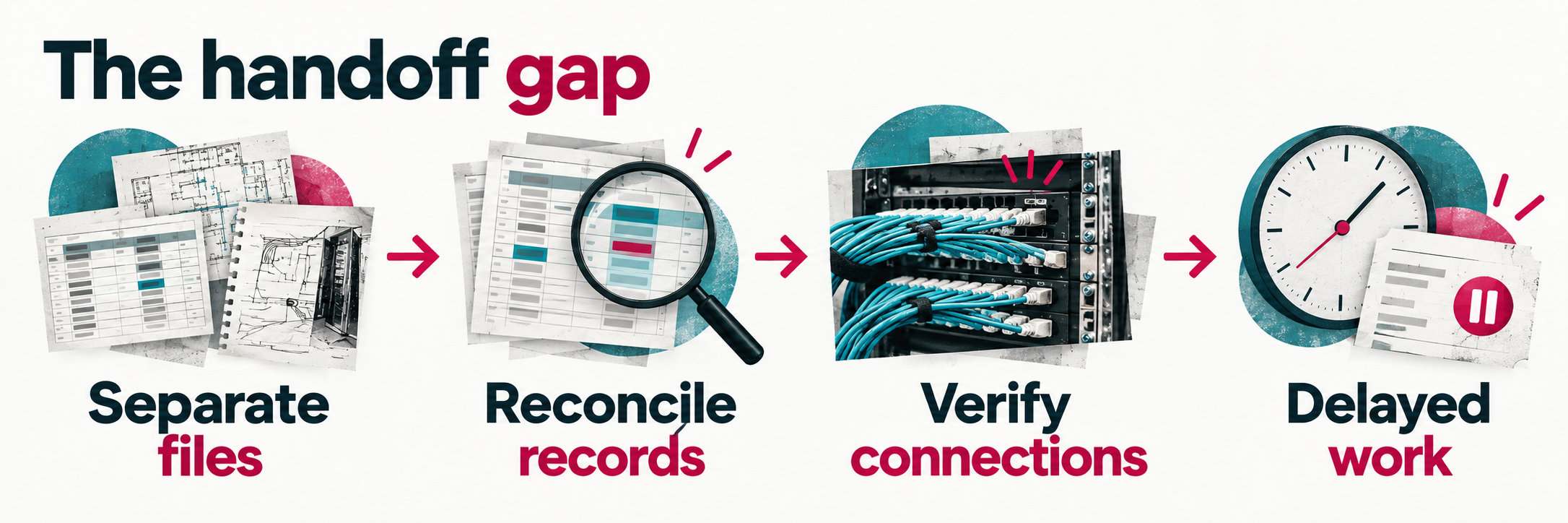
When the connections between records are missing, the next team has to reconstruct them.
As-Built Is a Starting Point
As-built documentation captures what was installed.
Then the network changes.
A circuit is added. A patch is moved. A spare strand is assigned. Someone who understood the original installation moves to another project or retires.
The customer now needs to know what exists today, how it connects and what is available for the next change.
That takes a maintained record—and an agreed process for updating it.
The next team should inherit the knowledge along with the network.
For a systems integrator, the opportunity starts while that knowledge is still being gathered: during design, installation, testing and validation.
Where the Chain Can Be Broken
A useful handoff connects the geographic view to the physical network the customer will operate.
With netTerrain OSP, teams can document routes, conduits, manholes, cables, strands and circuits. They can also document the equipment, racks, ports and connections inside facilities.
That means a question about a connection can be investigated through the documented infrastructure—from the outside plant to its indoor endpoints.
Existing spreadsheets and KML/KMZ files can provide a starting point. The integrator’s work includes connecting the information, resolving gaps and validating the model against the infrastructure delivered.
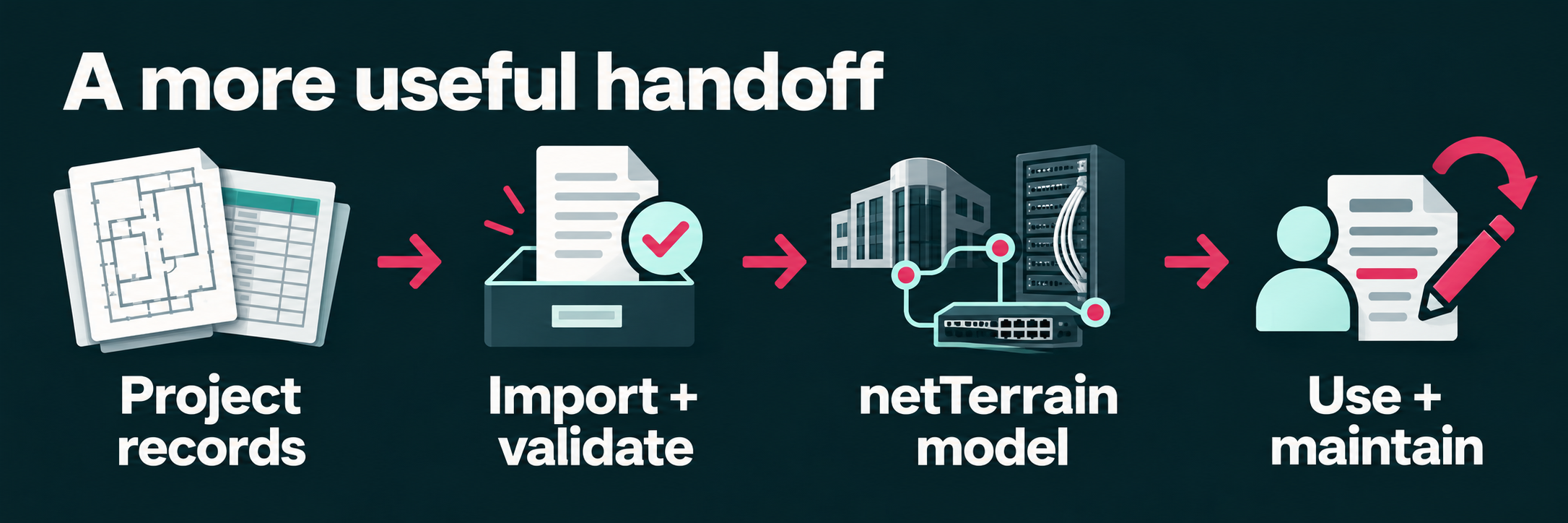
Integrator services establish the connected record. An agreed maintenance process keeps it useful after turnover.
The handoff should let the customer answer practical questions:
- Where does this documented circuit go?
- Which strands and ports are recorded as available?
- Where does the connection terminate?
- What needs to be updated when the next change is made?
Those answers are part of the deliverable.
BWI Had to Make the Knowledge Transferable
At Baltimore/Washington International Thurgood Marshall Airport, one person managed thousands of fiber connections. Preserving that knowledge for a future successor was a stated priority.
The airport’s previous software took 30 minutes to document a circuit. In its published netTerrain case study, BWI reports reducing that task to less than one minute.
The documented connections extended across multiple buildings and sites, with information accessible through a web browser.
That made the record easier to maintain—and gave the next person a foundation to work from.
The expertise could remain useful after the person who built the record moved on.
That is the kind of continuity worth planning into a modernization handoff.
The Integrator Can Deliver the Model, Too
This is where documentation becomes a meaningful part of the integrator’s solution.
The engineering, installation, splicing, configuration, testing and integration remain the integrator’s work. netTerrain provides a software platform around which the integrator can scope additional services.
Those services can include:
- Collecting and preparing the data: gathering route, cable, splice and termination records while the project team is working with the infrastructure.
- Building and validating the model: importing usable information, connecting the records and checking the result against the delivered network.
- Preparing the customer to use it: training operators and agreeing how additions, moves and changes will be recorded.
- Maintaining the record: defining ongoing documentation support where it fits the customer’s needs and the project scope.
For a federal modernization program, those responsibilities can be scoped alongside the other deliverables, with clear ownership at turnover.
The customer gets a more usable handoff. The integrator has another concrete service to deliver and support.
The value comes from making the team’s engineering knowledge usable for the life of the network.
Leave the Customer With Answers
Return to the question at the start: which strands are available, and where do they terminate?
A better handoff gives the operations team a maintained place to look, a documented path to follow and a process for recording what changes next.
That is a useful outcome to build into the project from the beginning.
Planning a federal network modernization, campus fiber deployment or data center project? See how netTerrain could fit the infrastructure documentation your team needs to deliver.
