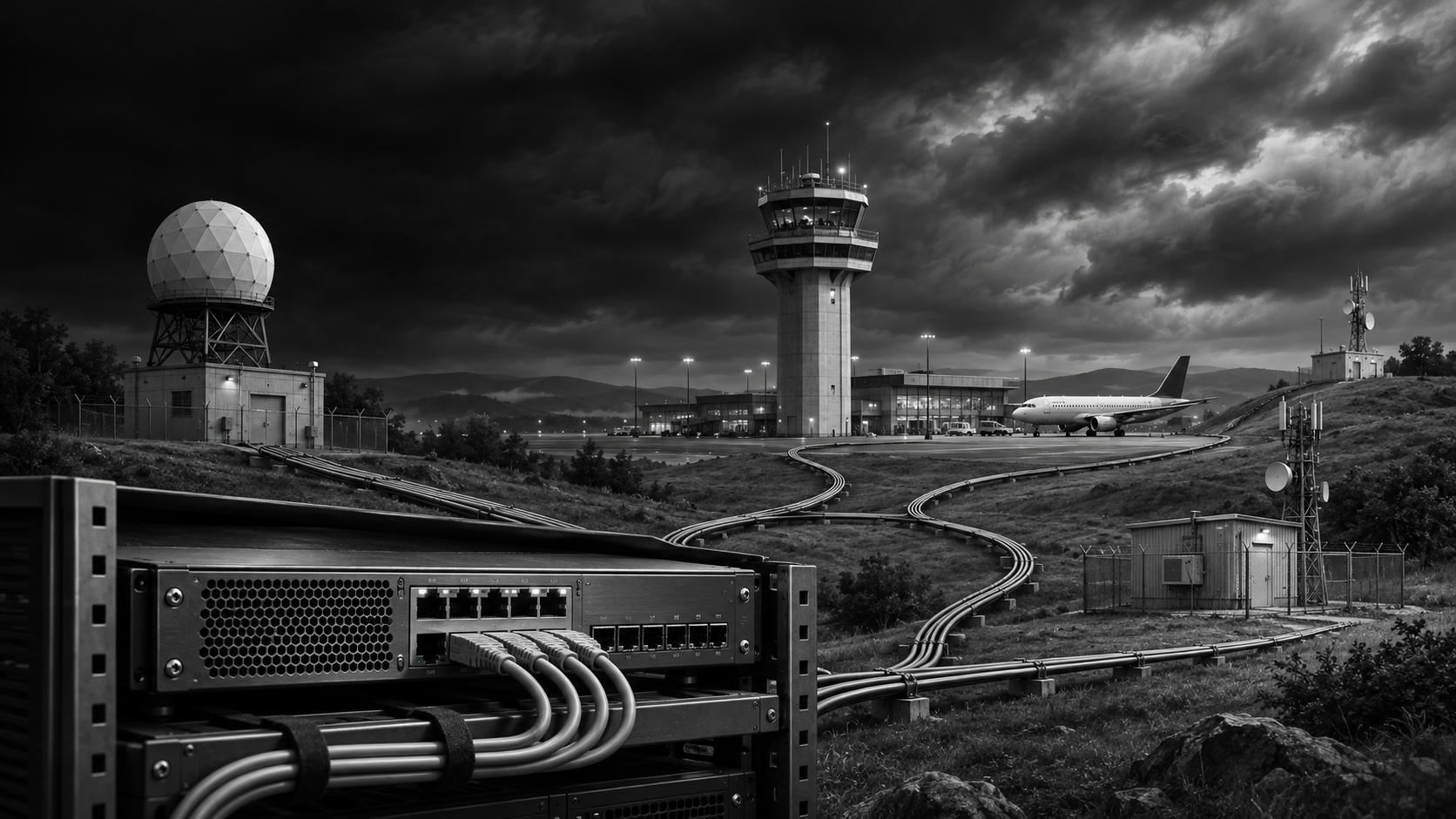
A router at a remote site may seem like a small part of a national network. The FAA’s November 13 ground stop is a reminder of how consequential network relationships can become—and why engineers need to understand more than the device they are changing.
The Incident: Two Remote Sites, 17 Control Centers
On Friday, November 13, 2026, the Federal Aviation Administration issued a nationwide ground stop after instability in the FAA Telecommunications Infrastructure (FTI) network affected aircraft communications and radar feeds. According to the FAA’s account, legacy telecommunications equipment was overwhelmed by approximately 1,000 connection attempts every four to five seconds. Problems reached 17 of the agency’s 22 Air Route Traffic Control Centers.
The FAA identified two potential sources of excessive network activity: a radar site near Amarillo, Texas, and a radio communications site in El Dorado, Arkansas. L3Harris had been performing work at El Dorado that included deploying a new router. After traffic from the two sites was isolated, the network stabilized. The ground stop lasted from approximately 3:30 p.m. to 8:15 p.m. Eastern.
Investigators have not established whether the underlying cause involved equipment, configuration, installation, interactions with older systems, or a combination of factors. Nor is there public evidence that missing documentation caused the disruption. That distinction is essential.
But the incident raises a question that reaches far beyond the FAA: Before anyone changes a device in a critical network, does the team understand what that device is connected to—and what depends on those connections?
There Is No Such Thing as “Just One Router”
On a basic network diagram, a router is a box. In a production environment, it can be an operational dependency for many other pieces of infrastructure.
What site is it in? Which interfaces are in use? What switches, ports and circuits connect to it? What IP networks and remote locations are involved? What upstream and downstream systems are documented? Where are the alternate paths? What changed recently? Who is responsible for the equipment and the records?
Those are not all the same kind of question. Some concern logical topology, others physical connectivity, equipment inventory, IP information, facility infrastructure or operational history. Yet an engineer making a change may need answers from several of those areas at once.
That is the problem with treating network documentation as a set of independent drawings, spreadsheets, PDFs and configuration exports. Each source may contain something useful. The challenge is knowing which information is current and how the pieces relate.
A Diagram Is Not the Same as a Living Infrastructure Record
Imagine a diagram showing Router A connected to Router B. It may be perfectly accurate as far as it goes. But what happens when an engineer needs to follow that connection through a specific interface, a patch panel, a rack, a WAN circuit, another facility and a system that relies on that route?
A static drawing does not necessarily tell you which ports are occupied, what the device’s current IP information is, which other records describe it, or whether its configuration and connections have changed since the picture was exported.
netTerrain addresses this as one platform with multiple capabilities. Its foundation is visual network and infrastructure documentation, with connected views that can include logical topology, assets and equipment, racks and cabling, IP information, circuits, geographic infrastructure, custom systems and operational data.
It is not three disconnected applications that engineers must reconcile every time they follow a connection. netTerrain Logical provides the underlying modeling and visualization; netTerrain DCIM adds more detailed data center and physical equipment management; and netTerrain OSP extends the model to geographic outside plant when needed.
The practical value is the ability to move among those documented layers instead of treating every layer as a separate answer. The netTerrain 10.2 End-User Guide describes the connected diagrams, path tools, IPAM, smart devices, reports and change-management functions in detail.

Before the Change: What Is the Blast Radius?
The question at the heart of a change review is simple: What could be affected if I disconnect or reconfigure this router?
A change review should be able to start with the device and follow the relationships the organization has actually documented:
- Network relationships: adjacent devices, interfaces, logical connections, routes and recorded system or application dependencies.
- Physical connections: the rack, cards, ports, patching, cables and equipment that carry the connection.
- IP and inventory information: device details, assignments, subnets, ownership and other operational properties.
- Geographic connections, when relevant: WAN facilities, outside plant cables, fiber paths and remote sites.
- Alternate paths: recorded primary and backup relationships, along with anything that still needs verification.
netTerrain provides tools to identify directly connected objects, inspect paths between documented nodes and navigate detailed circuit and cable relationships. Its DCIM capabilities add rack, equipment and port-level information, while the OSP module can extend that path through fiber routes and strands when the change involves outside plant. The platform can also represent custom service and application dependencies when those relationships have been modeled or brought in from other sources.
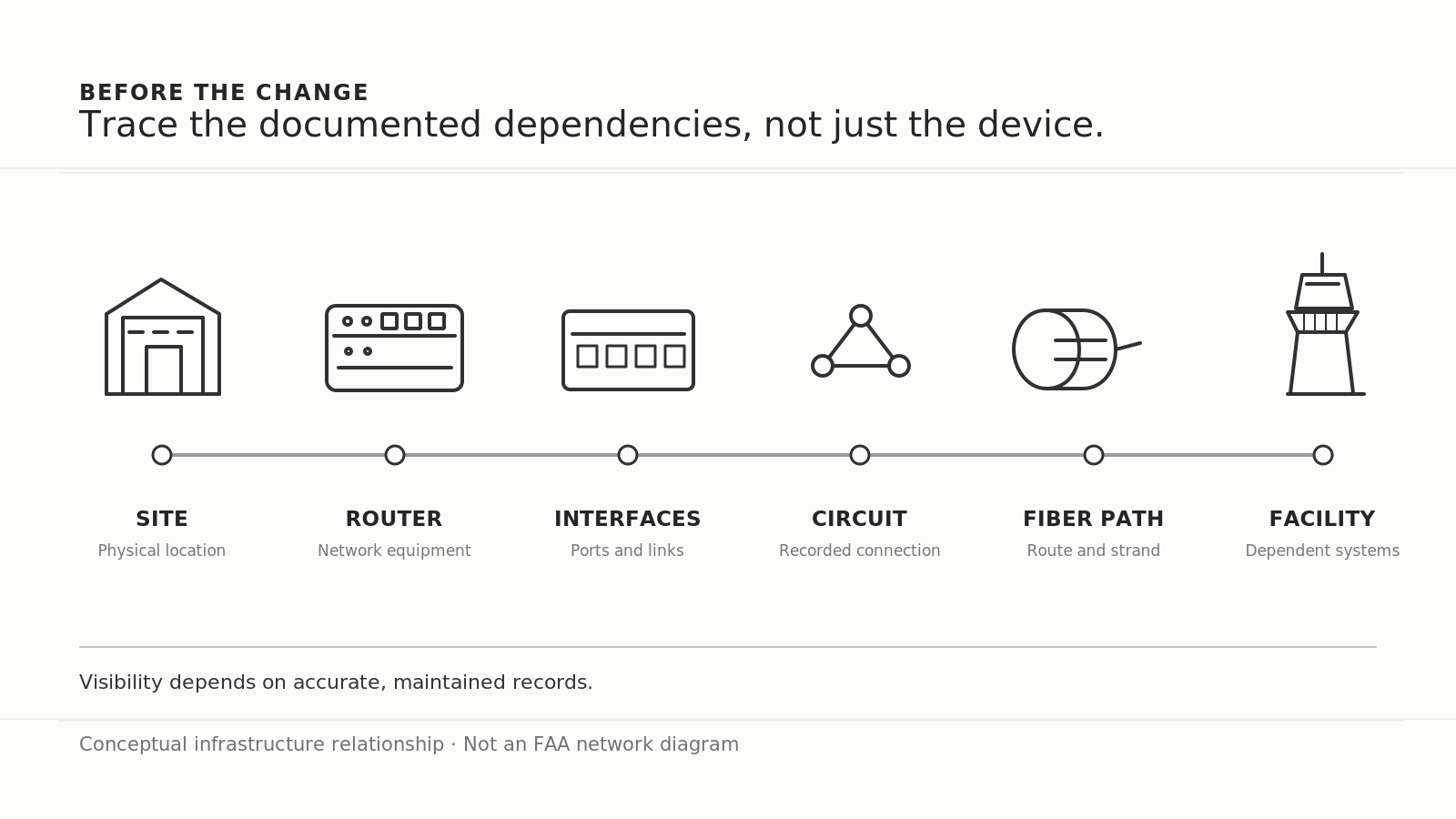
Documentation does not calculate every possible consequence automatically. An unrecorded application relationship or undisclosed carrier route remains an unknown. But a maintained, connected model can make the known dependencies visible—and expose the questions the team still needs to answer before the work begins.
During an Incident: Follow the Network, Not the Paper Trail
When something goes wrong, troubleshooting becomes a race against time. A team needs to know what changed, which devices and sites are involved, what their connections lead to, and where the problem might reasonably be isolated.
With netTerrain, engineers can search for an asset or IP address, open its logical and physical views, inspect connected devices and ports, and follow documented paths through the environment. Network discovery and the Collector can populate or reconcile discoverable devices, interfaces and links. Integrations with operational systems can bring additional inventory and status data into the model instead of leaving it scattered across tools.
Where configured, netTerrain’s monitoring, alerts and time-series information can add context for devices and ports. Reports and dashboards can help teams see infrastructure information across sites. The platform is not a packet-analysis system, and those capabilities do not, by themselves, determine why a router is generating unusual traffic. They do give engineers a more coherent picture of the environment in which they are troubleshooting.
That matters particularly in a geographically distributed network: a problem reported at one facility may involve devices and connections maintained by multiple teams hundreds of miles apart.
The Dependency Doesn’t Stop at the Data Center Door
One reason the FAA story is relevant well beyond fiber infrastructure is that a logical network path can lead into a room, rack, switch, server, power system or other operational dependency.
With netTerrain DCIM, teams can document equipment rooms and floor plans, rack layouts and capacity, devices, cards, ports, cabling, and power-related information. Those records answer questions a topology map alone cannot: Which rack houses the device? What is connected to its ports? Where is capacity available? What other equipment is physically involved?
Meanwhile, netTerrain Logical supports network topology and customizable system or application views, and IPAM connects address information with the infrastructure record. Outside plant is another layer—not the entire story.
For an engineer preparing a router refresh, understanding all of those layers may matter more than having a beautiful drawing of any one of them.
What Customers Demonstrate About the Bigger Picture
Bell Mobility: large-scale physical and network documentation. Bell reports using netTerrain to document roughly 20,000 devices across seven major data centers and about one million cables, including connections among routers, switches, servers and power equipment. Its team uses dynamic drawings, floor plans and color-coded racks to understand equipment and space. This is a DCIM and connectivity story at scale, not merely a fiber-mapping story. Read the Bell Mobility case study.
Acciona Energía: bringing operational systems together. The renewable-energy provider needed a common view across data center and control center operations. Using netTerrain DCIM and connectors to existing tools such as SolarWinds, CA Spectrum and ServiceNow, it brought multiple data sources into a shared visual environment. Its published case study describes a six-month implementation and an improved ability to identify affected infrastructure across departments. Read the Acciona case study.
BWI Airport: making infrastructure knowledge usable. BWI’s experience shows another part of the equation: the documentation must be practical to maintain. The airport reported reducing the time needed to document a circuit from approximately 30 minutes to less than one minute using netTerrain. That is a measure of documentation effort, not evidence that a particular outage was prevented. Read the BWI Airport case study.
These are different uses of the same platform: topology and connectivity, detailed facility and rack records, integrated operational data and circuit documentation. Together they illustrate why an infrastructure model should not be limited to a single technical discipline.
For Federal Agencies and Contractors, Who Owns the Whole Picture?
Federal modernization projects often cross ownership boundaries. One contractor installs network equipment; another manages circuits; a facilities team maintains racks and pathways; a service provider owns transport; and agency staff must operate the resulting environment after acceptance.
It is possible for each party to deliver its own drawings and still leave the agency without a connected record of the infrastructure. When the contract changes or an experienced engineer retires, the next team must reconstruct the relationships.
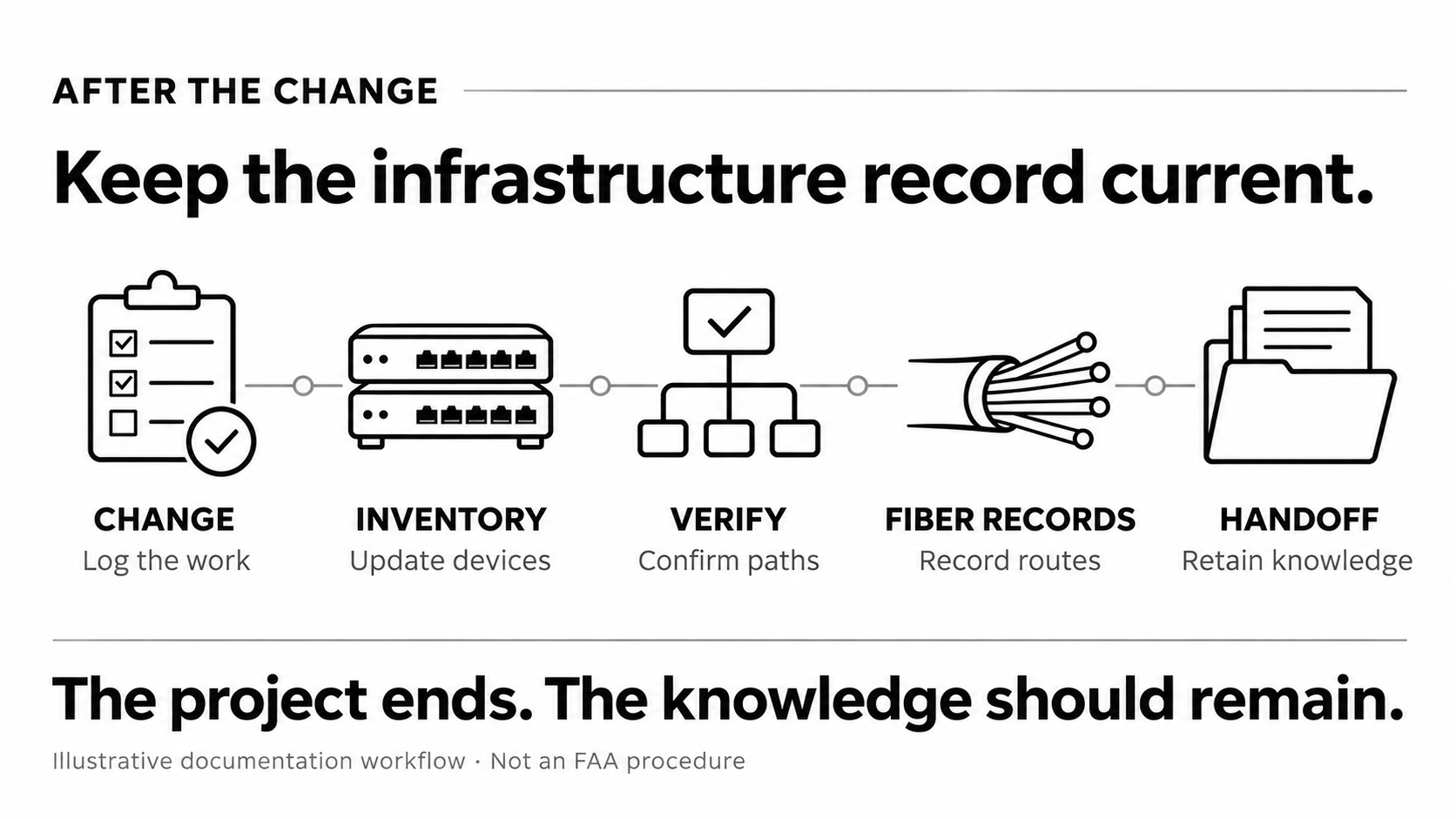
A more useful handoff includes verified device and inventory records, logical and physical connectivity, available IP and facility information, known dependencies, updates made during the work, and clearly identified gaps. netTerrain supports that work through shared visual views, permissions, attachments, reporting, APIs, audit history and work-order capabilities, as applicable to the deployment.
This complements established configuration-management practices, including the baseline, change-control and component-inventory controls described in NIST SP 800-53. A documentation platform is not a substitute for testing, security controls, operational approvals or agency-specific compliance requirements.
Documentation Won’t Prevent Every Outage
No documentation system can guarantee that hardware, software, configurations or network interactions will never fail. Good records do not replace change management, validation, monitoring, redundancy design or experienced engineers.
They strengthen the work surrounding those practices. Before a change, a team can examine recorded dependencies. During an incident, it can trace the known environment. After the work, it can update the record so the next engineer does not begin from an outdated drawing.
That is also why automated discovery is valuable without being magical: a discovered router does not prove that every service using it has been mapped, and a diagram is only as trustworthy as the data and processes maintaining it.
The Bigger Lesson: Do We Know What Depends on This?
A router might be one box. But the infrastructure supporting it can span interfaces, racks, IP networks, circuits, remote sites and operational services. The FAA investigation will determine what actually happened on November 13. It should not be used to claim that missing documentation caused the disruption.
It does, however, make one question impossible to ignore:
Before changing critical infrastructure, do we actually know everything we have documented as depending on it—and what remains unknown?
If the answer means finding the person who “knows the network,” opening five outdated drawings and reconciling multiple spreadsheets, the organization may be doing network archaeology instead of maintaining an operational infrastructure record.
For critical systems, that is a risky way to prepare for the next change.
See the Relationships in a netTerrain Walkthrough
For federal agencies and contractors managing network refreshes, facilities, data centers or multi-site infrastructure, we can demonstrate a representative, non-sensitive environment. See how netTerrain brings together network topology, discovered assets, device-to-port connectivity, racks, IP information, circuits and other documented dependencies—and how those records can support change reviews, troubleshooting and contractor handoffs.
Request a 1:1 netTerrain Infrastructure Walkthrough
Reporting reviewed November 16, 2026. The November 13 FAA telecommunications disruption is under investigation. The September FAA fiber-cut incident was separate. Illustrations are conceptual, not FAA network records. The customer examples describe their own published results and do not establish that netTerrain could have prevented this incident.
