The November 13 nationwide ground stop raises an uncomfortable question for federal agencies and network contractors: before a routine change, can you trace what depends on the infrastructure involved?
Friday, 3:30 p.m. Eastern
Across the United States, departures came to a halt.
On November 13, 2026, the Federal Aviation Administration issued a nationwide ground stop after its telecommunications infrastructure became unstable. The disruption reached 17 of the FAA’s 22 Air Route Traffic Control Centers and several terminal radar approach controls, according to the agency’s November 15 public account. The FAA says the ground stop was a safety precaution, certain radio and radar services remained available, and aircraft already airborne landed safely.
The immediate investigation led toward two remote locations: a radar site near Amarillo, Texas, and a radio communications facility in El Dorado, Arkansas. At El Dorado, L3Harris had been performing work that included deployment of a new router.
What happened at those remote sites that could affect the national air traffic system?
Investigators are still establishing the answer. But the sequence already raises a practical question for federal network owners and the contractors who modernize their infrastructure: before a seemingly routine change, how confidently can you trace what depends on it?
Exhibit A: 1,000 Connection Attempts Every Four to Five Seconds
The FAA says legacy equipment became unstable when data flooded the FAA Telecommunications Infrastructure (FTI) network at approximately 1,000 connection attempts every four to five seconds. The resulting instability affected aircraft communications and radar feeds.
The agency identified the Amarillo and El Dorado locations as potential sources, and says the network stabilized after L3Harris blocked traffic from both sites. As an additional precaution, the FAA disabled the same broadcasting functionality on approximately 60 similar routers. Read the FAA’s technical Q&A.
Reuters reported on November 16 that a router at the Amarillo site had reportedly been replaced roughly three weeks before the incident. The government is investigating the role of equipment, installation and configuration.
The FAA’s account distinguishes routine remote-facility replacement work from its broader modernization effort. The Department of Transportation’s November 14 briefing provides additional context about the copper-to-fiber transition and the questions still under review.
The ground stop began at approximately 3:30 p.m. Eastern and was lifted at 8:15 p.m. It was an enormous operational consequence associated with infrastructure at facilities most passengers will never see.
Exhibit B: What the Investigation Has Not Established
The public findings do not establish that outdated network diagrams, poor documentation or inadequate change records caused this incident. Nor has the root cause been conclusively attributed to one router, one technician or one contractor. The FAA and L3Harris are still investigating.
That distinction matters. The confirmed event is a major telecommunications disruption in the context of routine network work. The broader lesson is the value of understanding the dependencies surrounding infrastructure changes—whether or not documentation turns out to have played a role here.
There Is No Such Thing as “Just One Router”
In a simple diagram, a router is a box. In a production environment, it can be an operational dependency. A device at one site may connect through multiple interfaces and circuits to remote facilities, service providers, network segments and essential functions.
Before a replacement or cutover, a federal network engineer needs to know far more than where the device is installed. The questions include:
- Which devices, ports, interfaces and circuits connect to it?
- Which remote sites, services and systems are documented as depending on those paths?
- Does an alternate route exist—and are its physical dependencies actually different?
- What other equipment sits upstream and downstream?
- Which records and configurations must be checked and updated after the change?
- Who owns the record and validates what was installed?
A conventional drawing might show a router connected to a WAN. A maintained infrastructure record can connect that router to locations, interfaces, circuits, fiber strands, patch panels, ports and other documented relationships. The goal is not one enormous diagram; it is an answer that can be followed from one layer to the next.
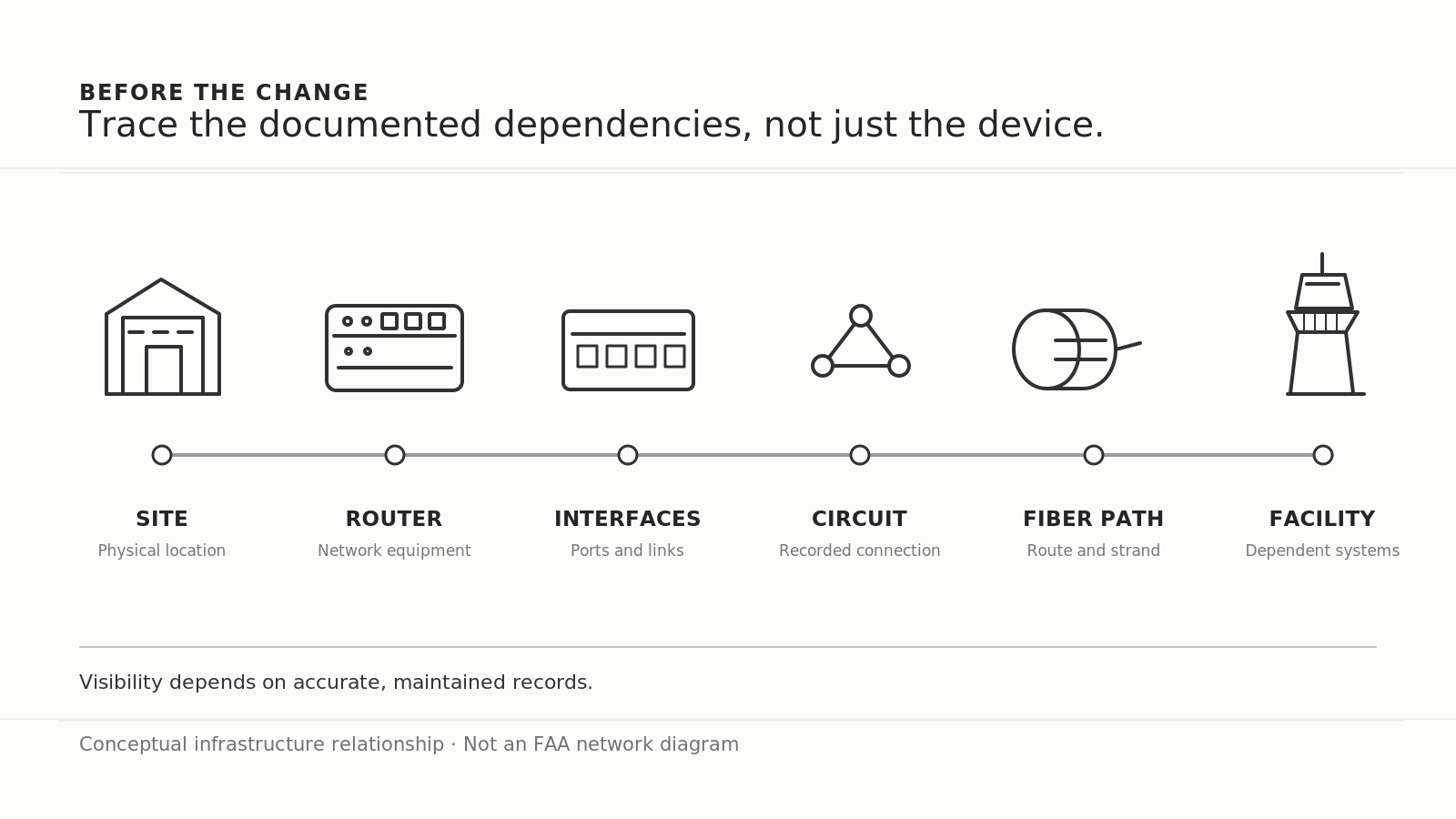
That is the difference between knowing what equipment exists and understanding what it supports. It is also why a collection of spreadsheets, PDFs and old Visio files cannot automatically be treated as a current picture of the network.
For Federal Agencies, This Is a Mission-Continuity Question
Civilian agencies, military installations, laboratories, depots and other distributed government environments often modernize networks in stages. New technology must coexist with older infrastructure.
Some assets are government-owned; others are contractor-managed. Circuit information may live with a carrier, physical cable records with facilities and configuration data with the network team.
Each group may have useful records. The difficult question is who keeps the relationships across those records accurate when equipment, people and contracts change.
A useful change review should establish which infrastructure is involved, where the known dependencies lead, who will verify the implemented connections and how the government will retain usable records after the project.
These questions complement—not replace—formal configuration management, testing, maintenance approvals, contingency planning and monitoring.
NIST SP 800-53 includes configuration-management controls such as CM-2 (baseline configuration), CM-3 (configuration change control) and CM-8 (system component inventory). NIST SP 800-171 Rev. 3 addresses relevant requirements for certain nonfederal systems handling controlled unclassified information when applicable through contracts or other agreements.
Software can support the underlying records and workflows; it does not establish compliance by itself.
For Contractors, the Deliverable Is More Than Installed Equipment
Consider a prime contractor or integrator completing a federal network refresh, fiber deployment or multi-site cutover.
The team installs devices, validates connectivity and passes acceptance tests. Then the project closes.
What does the agency inherit? A folder of as-built PDFs and spreadsheets? Or a maintained, navigable model of the infrastructure that was actually delivered?
A stronger handoff lets the next engineering team see recorded equipment, circuits, terminations, routes and relationships without reconstructing the project from disconnected files.
It also gives the contractor an opportunity to make documentation and validation a defined part of the scope of work, rather than a final administrative step.
That is especially important during re-competes, personnel transitions, maintenance-contract turnover and follow-on projects.
The installation might be complete. Is the knowledge transferable?
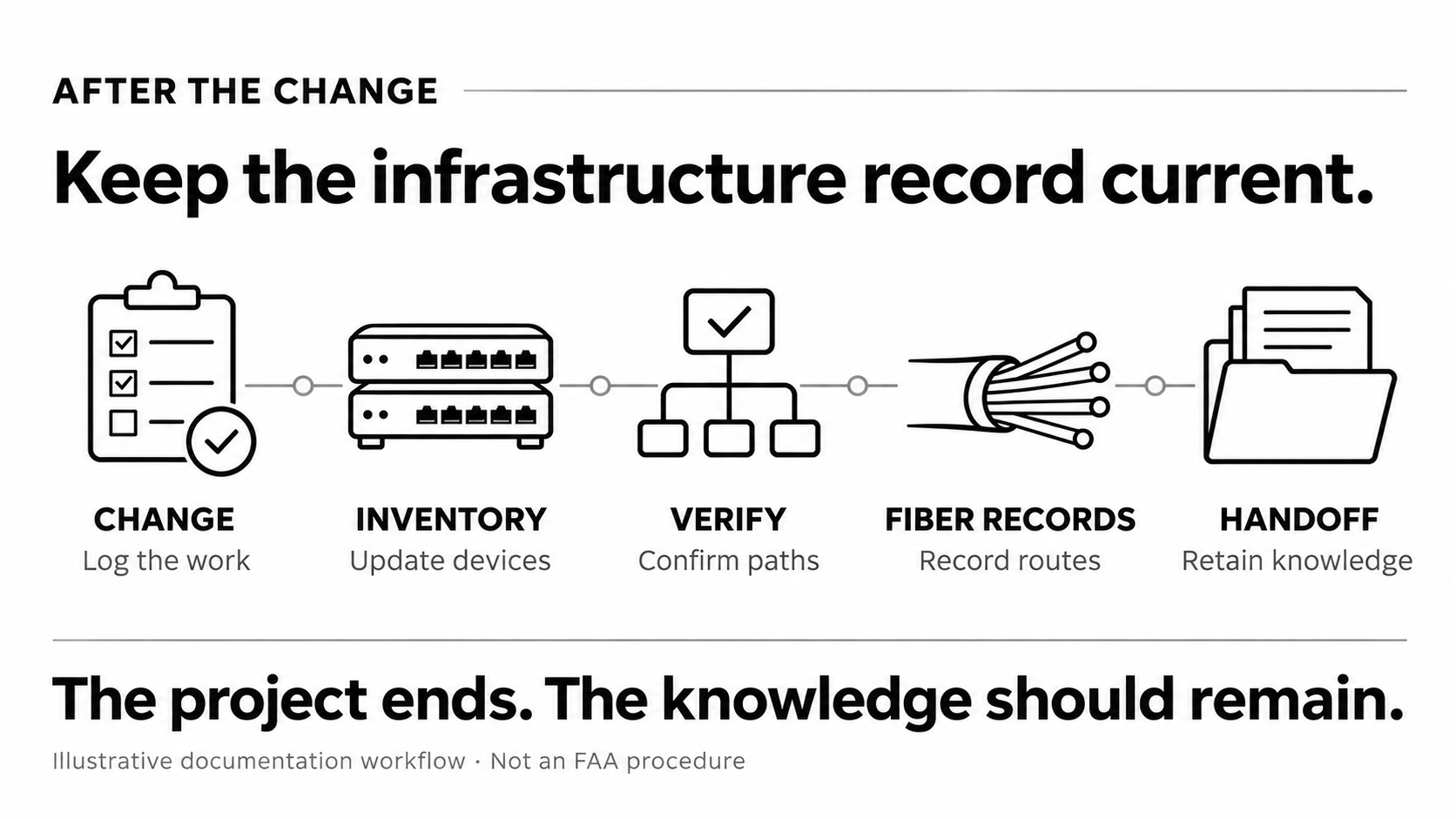
Exhibit C: What BWI Airport Actually Measured
Baltimore/Washington International Thurgood Marshall Airport provides a separate, concrete example. BWI was not part of this November FAA incident. Its experience instead shows the operational value of reducing the effort required to maintain large-scale infrastructure records.
BWI had thousands of fiber connections across multiple sites. Its previous system required approximately 30 minutes to document one circuit.
After adopting netTerrain, the airport reported reducing that task to less than one minute, with records accessible through a web browser. The result is documented in the BWI Airport case study.
“Plus, when I retire, I know that my work will be retained for the next person.”
Dwayne Abrams, BWI Airport
That figure measures documentation effort—not downtime avoided or outages prevented. But it illustrates why usability matters: an infrastructure record cannot remain current if maintaining it becomes an impractical burden.
The issue extends beyond airports. Our earlier article, The Network Is New. The Documentation Problem Isn’t., examines how federal modernization handoffs can leave a new system with old documentation gaps.
Our analysis of September’s separate FAA fiber-cut incident addresses a different failure; the November 13 telecommunications instability should not be mistaken for that confirmed September fiber cut.
Where netTerrain Fits—and Where It Does Not
netTerrain OSP helps organizations document and navigate outside plant infrastructure, including routes, conduits, cables, strands, circuits, splices and facility terminations.
The broader netTerrain platform connects physical and logical infrastructure information, with discovery and integrations supporting data collection for discoverable equipment and network relationships. See netTerrain for government infrastructure.
For a change review, that means teams can work from documented site, device, interface, circuit and fiber relationships instead of first reconciling separate diagrams.
During an incident, it provides a place to begin tracing recorded dependencies. At project closeout, it provides a structured way to retain the infrastructure knowledge collected and verified by the contractor.
No tool can guarantee complete visibility or prevent every failure. Discovery does not automatically verify buried fiber routes, physical patching, non-discoverable dependencies or changes that were never recorded.
Documentation works when it is coupled with ownership, field validation where appropriate, change discipline and operational testing.
The Unanswered Question Before the Next Change
Investigators will continue working to determine why the FAA’s telecommunications system became unstable on November 13. Their eventual findings may explain specific equipment behavior, configuration conditions or interactions between old and new infrastructure.
In the meantime, every agency and contractor responsible for critical networks can ask a useful, testable question:
Before the next router replacement, fiber cutover or network modernization project, can our team trace the affected infrastructure—and show that the records are current?
For the agency, that knowledge supports continuity across people and contracts. For the contractor, it is a more durable deliverable. For the engineer responding to a problem, it means having a starting point instead of a search through network archaeology.
For federal agencies & contractors
Can you trace the infrastructure behind your next change?
See a representative, non-sensitive netTerrain walkthrough of documented sites, equipment, ports, circuits and fiber relationships—and how that information can support modernization and contractor handoffs.
Reporting reviewed November 16, 2026. The November 13 nationwide ground stop and September 2026 FAA fiber-cut incident were separate events. The illustrations are conceptual and do not depict FAA infrastructure. This article discusses infrastructure-documentation practices, not a forensic conclusion about the incident or a claim that software would have prevented it.
